

The Wonder of Looking Up
There’s something profoundly calming about gazing at the night sky. Whether you’re sitting around a campfire, standing in your backyard, or escaping the city lights, the stars have a unique way of shrinking our pride while awakening our wonder.
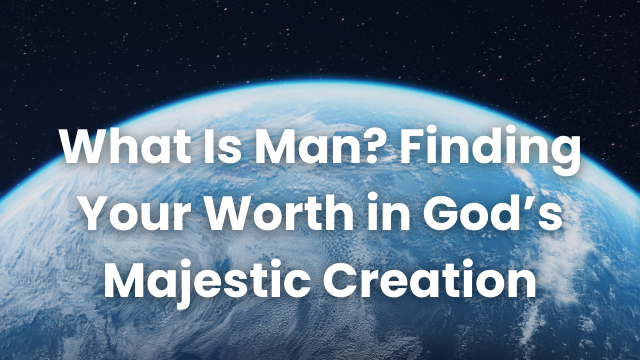
The early astronauts described a transformative experience when viewing Earth from space. Borders disappeared. Political divisions vanished. Human ego evaporated. They were overwhelmed by both the greatness of creation and the fragility of mankind—a powerful reminder of a Creator with an amazing imagination.
This same sense of awe inspired King David thousands of years ago when he penned Psalm 8. Looking upward at the heavens, he asked one of Scripture’s most profound questions: “What is man that you are mindful of him?”
Three Questions That Define Our Existence
Psalm 8 addresses three enormous questions that every human being wrestles with:
- Who is God?
- Who are we?
- Why does any of this matter?
David’s answer begins and ends with the same declaration: “O LORD, our Lord, how majestic is your name in all the earth!” Everything in between is framed by the glory of God. While this psalm appears to focus on humanity, it’s ultimately about God’s majesty.
God’s Glory Beyond Comprehension
“You have set your glory above the heavens,” David writes in verse 1. As a shepherd who spent countless nights under the stars watching his father’s flocks, David saw God’s fingerprints everywhere—in the twinkle of stars, the glow of the moon, the sway of trees, and the fragrance of flowers. Each element of creation testifies to God’s glory.
This theme echoes throughout Scripture. Psalm 19 declares, “The heavens declare the glory of God.” Paul writes in Romans 1:20 that creation reveals God’s eternal power and divine nature.
Consider this: David experienced this wonder without telescopes, observatories, or satellite imaging. Modern astronomy tells us there are billions of galaxies, each containing billions of stars. If David was overwhelmed by what he could see with the naked eye, how much more should we be amazed?
Knowledge Without Wonder
A scientist can explain the mechanics of a sunset—light refraction, atmospheric particles, wavelengths of color. But explanation doesn’t erase wonder. In fact, the deeper we understand creation’s complexity, the more it should increase our awe.
The problem in modern culture isn’t that we know too much—it’s that we worship too little. We have knowledge but lose reverence. We can measure stars but forget the God who hung them.
Many people today live with anxiety because their world has become too small. Everything revolves around my problems, my schedule, my stress, my plans. Psalm 8 invites us to lift our eyes upward and remember: God is still God, and He is still in control.
The Dignity God Gives to Humanity
David’s question—”What is man that you are mindful of him?”—expresses genuine astonishment that the God who made galaxies even notices humanity. Yet He does, and profoundly so.
David isn’t saying humanity is worthless. He’s saying humanity is small compared to God. There’s a crucial difference. Culture swings between two extremes:
- Pride: “Humanity is everything”
- Despair: “Humanity is nothing”
The Bible teaches neither. We are not gods, nor are we accidents.
Created in God’s Image
Verse 5 declares: “Yet you have made him a little lower than the heavenly beings and crowned him with glory and honor.” This reaches back to Genesis 1:26-27, where humanity is made “in the image of God.”
This doesn’t refer to physical appearance—hair color, height, or looks. It means every human life carries inherent value, not because of wealth, intelligence, or success, but because God placed His image upon humanity.
Think of it this way: A crumpled dollar bill still carries value because of whose image and authority is stamped on it. Similarly, even though humanity is fallen, broken, and scarred by sin, the image of God still gives us dignity.
This truth has profound implications:
- Racism is evil because it dishonors God’s image-bearers
- Abuse is evil because it attacks those God values
- Exploitation is evil because it treats people as objects rather than image-bearers
Identity in an Age of Confusion
We’re living in a time of widespread identity confusion. People everywhere are asking: Who am I? Why do I matter? What gives life meaning?
Psalm 8 answers clearly: You matter because God made you and cares for you.
Your identity isn’t rooted in achievement, social media followers, or public opinion. Your deepest identity is that you were created by God intentionally. For believers, this goes even further—through Christ, we are redeemed children of God.
Humanity’s Responsibility as Caretakers
David writes: “You have given him dominion over the works of your hands.” Humanity was created not only with dignity but with responsibility. We are caretakers under divine authority.
This means creation matters. Christians should never embrace careless living toward God’s creation. When we remember it’s God’s world—not merely ours—we naturally take better care of it.
We rule under God; we are not ultimate rulers. That’s where humanity fell. We wanted authority without submission, crowns without obedience. The result was the fall, which fractured everything—relationships, nature, leadership, and all humanity.
The Broken Mirror
Imagine a mirror reflecting light, just as we’re meant to reflect God’s image. What happens when that mirror cracks? It still reflects, but the image is distorted. Sin distorted the image of God in us.
This explains why humanity is capable of breathtaking beauty and horrifying evil simultaneously. We build hospitals and start wars. We compose symphonies and commit violence. We invent medicine and spread hatred. The image remains, but sin corrupted the reflection.
Jesus: The Perfect Fulfillment of Psalm 8
Fascinatingly, this psalm ultimately points beyond David to Jesus Christ. In Hebrews 2:6-9, the writer quotes Psalm 8 and applies it directly to Christ.
The passage explains that while we don’t yet see everything in subjection to humanity, “we see him who for a little while was made lower than the angels, namely Jesus, crowned with glory and honor because of the suffering of death, so that by the grace of God he might taste death for everyone.”
Where humanity failed to rule rightly, Jesus succeeded. Where Adam fell, Jesus obeyed. Where humanity rebelled, Jesus submitted to the Father perfectly.
Jesus was made “for a little while lower than the angels”—He entered humanity, experiencing weakness, suffering, temptation, and death. Why? So broken humanity could be restored.
The Crown After the Cross
Notice the past tense: “crowned with glory and honor.” Hebrews connects that crown to Christ after His suffering. The cross came before the crown. Jesus wore a crown of thorns before receiving the crown of glory.
Only through belief in God’s Son can humanity be restored to its former glory. Salvation is more than forgiveness—it’s restoration. It’s reclaiming what sin distorted and fixing the broken mirror once and for all.
Our Response: Worship
David ends where he began: “O LORD, our Lord, how majestic is your name in all the earth!”
True theology always leads to worship. When we understand God’s greatness, humanity’s dignity, sin’s destruction, and Christ’s redemption, the only fitting response is awe.
Don’t become numb to God’s majesty in today’s chaotic world. Don’t scroll past beauty, rush past grace, or normalize miracles.
Psalm 8 invites us to recover wonder—wonder at creation, wonder at the gospel, and wonder that the God who made galaxies knows your name and hears your whispered prayers.
The Question That Changes Everything
When David looked at the heavens and asked, “What is man?” the gospel answers: Humanity is fallen but deeply loved by God. Loved so much that Christ came, died, and rose again.
As you look at the stars tonight, the real question isn’t merely “Does God exist?” The greater question is: What will you do with the God who is mindful of you?
If you feel insignificant, forgotten, overwhelmed, or spiritually distant today, Psalm 8 reminds you: The God who hung the stars has not forgotten you. Jesus Christ stepped into human history so you could be restored to God. The Creator became Savior.
Forgiveness, grace, purpose, and eternal life are available if you believe.
Look up toLook up to Christ and worship with those same words of David: “O LORD, our Lord, how majestic is your name in all the earth!”
Practical Steps to Reclaim Wonder
Understanding Psalm 8 intellectually is one thing; living in its truth is another. Here are practical ways to apply this ancient psalm to your modern life:
1. Practice “Sky Theology”
Make it a habit to step outside and look up. When anxiety threatens to overwhelm you, when your problems feel insurmountable, when you’re drowning in the noise of daily life—pause and gaze at the sky.
Whether it’s the stars at night, clouds during the day, or the vastness of a sunset, let creation remind you of the Creator. Your burden is not bigger than His power. Your confusion is not greater than His wisdom. Your future is not outside His control.
2. Reject False Identities
In a world obsessed with self-definition, Psalm 8 offers liberating truth: your identity is given, not constructed. You don’t have to earn your worth through performance, popularity, or productivity.
Stop letting social media metrics, career achievements, or others’ opinions define you. Your value was established at creation and secured at the cross. You are God’s image-bearer, redeemed by Christ.
3. Steward Creation Responsibly
If God entrusted humanity with dominion over His creation, how are you caring for what He’s given? This doesn’t mean embracing every environmental ideology, but it does mean rejecting careless consumption and wastefulness.
Consider: How do your daily choices reflect gratitude for God’s creation? Are you treating His world with the respect it deserves?
4. See Others Through God’s Eyes
Every person you encounter—regardless of race, status, ability, or background—bears God’s image. This should transform how you treat the cashier, your difficult coworker, the homeless person on the corner, and even your political opponents.
To dishonor people made in God’s image is to dishonor the God whose image they bear. Let this truth shape your words, actions, and attitudes.
5. Embrace Your Smallness
Our culture celebrates self-promotion and personal branding. Psalm 8 invites us to embrace our smallness before God—not as worthlessness, but as proper perspective.
When you understand how vast God is and how small you are in comparison, it paradoxically increases your significance. You matter not because you’re big, but because the big God notices you, loves you, and sent His Son for you.
The Gospel in the Stars
Psalm 8 ultimately points us to the gospel story written across creation and history:
- Creation: God made humanity in His image with dignity and purpose
- Fall: Sin shattered that image and broke our relationship with God
- Redemption: Jesus became human, lived perfectly, died sacrificially, and rose victoriously
- Restoration: Through faith in Christ, we are being restored to our intended glory
The same God who spoke galaxies into existence spoke your name before you were born. The same hands that shaped mountains reached down to lift you from sin. The same voice that commands the stars whispers, “You are mine.”
A Final Invitation
Perhaps you’ve read this far and still wonder: Does God really care about me? Am I truly valuable? Can someone like me be restored?
The answer thunders from Psalm 8 and echoes through the gospel: Yes.
You are not an accident. You are not forgotten. You are not beyond redemption.
The God of the universe is mindful of you. He knows your name, your struggles, your fears, and your deepest longings. He loved you enough to send Jesus—not just to die for humanity in general, but for you specifically.
Salvation is available today. Not because you’ve earned it or deserve it, but because God’s grace is that magnificent. The Creator became Savior so that broken mirrors could be made whole again.
Living in the Wonder
As you go about your week, carry Psalm 8 with you. When stress mounts, look up. When identity questions arise, remember whose image you bear. When you’re tempted to despair, recall that the God who made everything made you—and He doesn’t make mistakes.
Let David’s words become your prayer, your declaration, your worship:
“O LORD, our Lord, how majestic is your name in all the earth!”
The stars are still shining. The Creator is still creating. The Savior is still saving.
And you—yes, you—matter more than you could ever imagine.
What will you do with the God who is mindful of you? That’s the question Psalm 8 leaves us with. Not as a burden, but as an invitation into wonder, worship, and restored relationship with the One who hung the stars and knows your name.
May you never lose the wonder.