

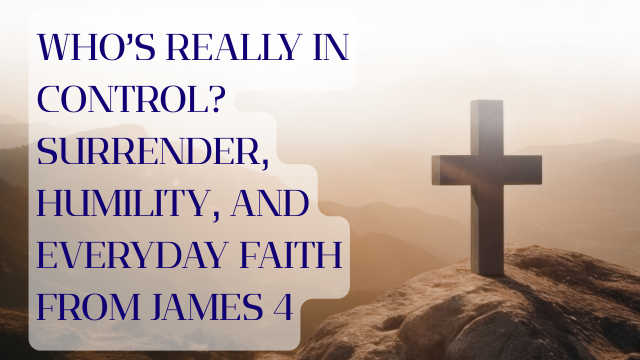
When life feels chaotic or out of control—whether it’s a health report, a broken relationship, or just the daily pressures we all face—the question at the heart of James 4 rings loudly: who is really in control—God or us?
This week at Lakeview Christian Church, we explored James 4 and the invitation to move from prideful self-reliance to humble surrender. The message challenges us to examine not just our actions, but the desires and motives that fuel our conflicts, distort our prayers, and shape our future plans. Let’s dig deeper into what it means to let go of our need for control and embrace God’s authority over every part of our lives.
The Heart of the Issue: Pride vs. Humility
James 4 starts with a probing question:
“What causes quarrels and what causes fights among you? Is it not this, that your passions are at war within you?” (James 4:1, ESV)
Our struggles with others, and even our internal conflicts, often flow from unchecked desires—wanting our way, needing control, or demanding recognition. Pride tells us, “I know best; I can do this on my own.” But humility recognizes God as the true authority.
James warns,
“God opposes the proud but gives grace to the humble.” (James 4:6, ESV)
True humility is not just feeling lowly but placing ourselves under God’s leadership—letting His Word and wisdom have the final say.
Drawing Near to God
So what do we do when we find ourselves in conflict or wrestling for control? James offers a beautiful invitation:
“Draw near to God, and he will draw near to you. Cleanse your hands, you sinners, and purify your hearts, you double-minded.” (James 4:8, ESV)
God doesn’t push us away when we fail or struggle. He calls us back, inviting us to confess, repent, and return. The story of the Prodigal Son (Luke 15:17-24) echoes this truth—when we come to our senses and turn back to God, the Father runs to meet us with compassion and restores what’s been broken.
Surrendering Our Plans
Planning isn’t wrong—Scripture encourages diligence and stewardship. But James cautions us not to make plans as if we are in control of tomorrow:
“Yet you do not know what tomorrow will bring. What is your life? For you are a mist that appears for a little time and then vanishes. Instead you ought to say, ‘If the Lord wills, we will live and do this or that.’” (James 4:14-15, ESV)
Living with “if the Lord wills” isn’t just a phrase; it’s a posture of the heart—acknowledging God’s sovereignty and trusting His wisdom above our own.
Practical Action Steps
- Pause in Conflict: When disagreements arise, ask yourself, “What desire of mine is being threatened?” Take time to pray before reacting.
- Confess and Repent: Be honest with God about areas of pride or control. Ask Him to reveal where you need to surrender.
- Restore Relationships: Is there someone you need to forgive, or an apology you need to make? Take the first step.
- Pray for Humility: Regularly ask God to cultivate a humble heart—one that seeks His will above your own.
- Align Your Plans: Before making decisions about the future, pray, “Lord, not my will, but Yours be done” (see Luke 22:42, ESV).
Conclusion: Everyday Faith Means Surrendering Control
James 4 reminds us that everyday faith is less about getting God to bless our agenda and more about surrendering our agenda to Him. Whether you’re facing uncertainty, conflict, or the temptation to take matters into your own hands, remember: God’s grace is available for the humble. He welcomes us back, restores us, and leads us into true freedom.
Prayer
You might close your time with this prayer:
“Father, thank You that I don’t have to be in control. Forgive me for the ways I’ve tried to run my life on my own terms. Help me to surrender every area—my desires, my relationships, my future—into Your hands. Give me a humble heart that seeks Your will above my own. Teach me to draw near to You daily, trusting that Your plans are better than anything I could imagine. In Jesus’ name, Amen.”